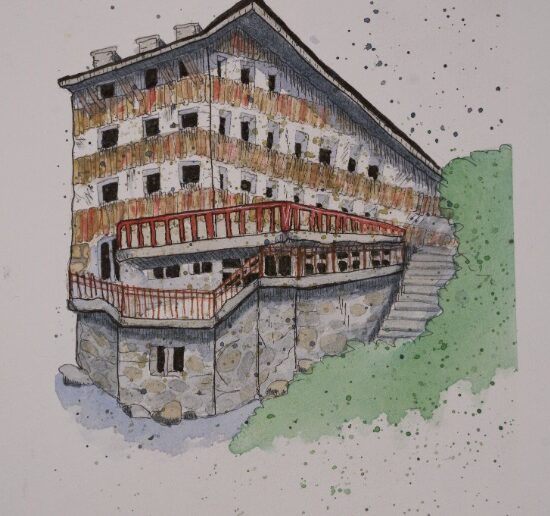
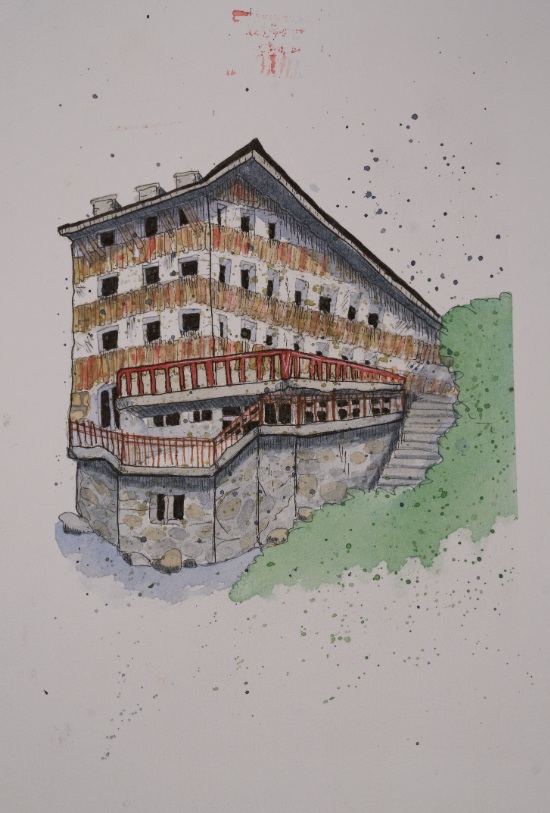
Bezbog Hut. Ink and Watercolour on 300g Watercolour Paper
A5
Framed
Urban Sketching: An Intuitive Community Practise
Urban sketching is not about perfection. It is not about straight lines, exact proportions or architectural accuracy. It is about being present — fully, honestly, and without the safety net of erasing or reworking. When I sit in front of a mountain hut with my sketchbook, I am not trying to reproduce it as a camera would. I am writing it.
Ink lines, for me, are just another form of handwriting. They flow across the page the same way thoughts flow across a journal. They are not measured or calculated; they are gestures, movements, responses. When I draw a roofline or the edge of a window, I am not drafting it — I am writing its shape. The pen moves with the rhythm of my breath, the weight of the moment, the unevenness of the ground beneath me. The line becomes a sentence, the sketch a paragraph, the page a story.
Urban sketching embraces the imperfect because life itself is imperfect. A mountain hut is never really symmetrical. Stones shift, wood warps, shadows move. I, too, am shifting — my hand, my mood, the light, the wind. I have no drawing desk. I hold the sketchbook in my hand and write into it what I see. The drawing becomes a record of all these small changes. It captures not only what I see, but how I see it right now, in this fleeting moment, and how the fountain pen writes on the paper.
This is why urban sketching feels alive. The ink dries quickly, leaving no room for correction. The lines wobble, overlap, or wander off. Wonky frames and smudges are part of the process, especially if it rains and the rain dilutes the ink. But these imperfections are not mistakes — they are evidence of presence. They show that I was there, observing, responding, letting the world flow through my hand.
A sketch is not a photograph. It is a conversation. It is an experience. Looking back at my sketches, it’s not the technical details that I remember, but instead the air, the sounds, the warmth of the sun, the smell of the wood, the quietness of the place. The curious people watching. Sketching is not an isolated act in a drawing room. Sketching is live, unprotected, visible. It inevitably leads to interactions with people: Curious glances, questions, comments, laughter and surprise „I know this place“ or „this is my house! Somebody painted my house!“ In a time of digital perfection, who has had the experience of seeing the own house or garden or city painted by hand by a person sitting in front of you? Sketching is a community act.
Urban sketching teaches me to let go of control, to trust the line, to trust the moment. It teaches me that beauty lies in the imperfect, the spontaneous, the unpolished. It teaches me to write the world with my pen — one line at a time.